


A retractable reel is only of value if it is properly attached. Too low, it drags. Too high, the cable does not reach what it needs to reach. Poorly attached, it falls at the wrong moment. And depending on the workwear worn, the fastening options are not the same.
This is a point that many new users underestimate. They choose their model carefully, consider the cable length, and overlook the fixing. Yet it's this very aspect that dictates daily comfort.
Here's how to approach the question depending on the type of clothing you're wearing.
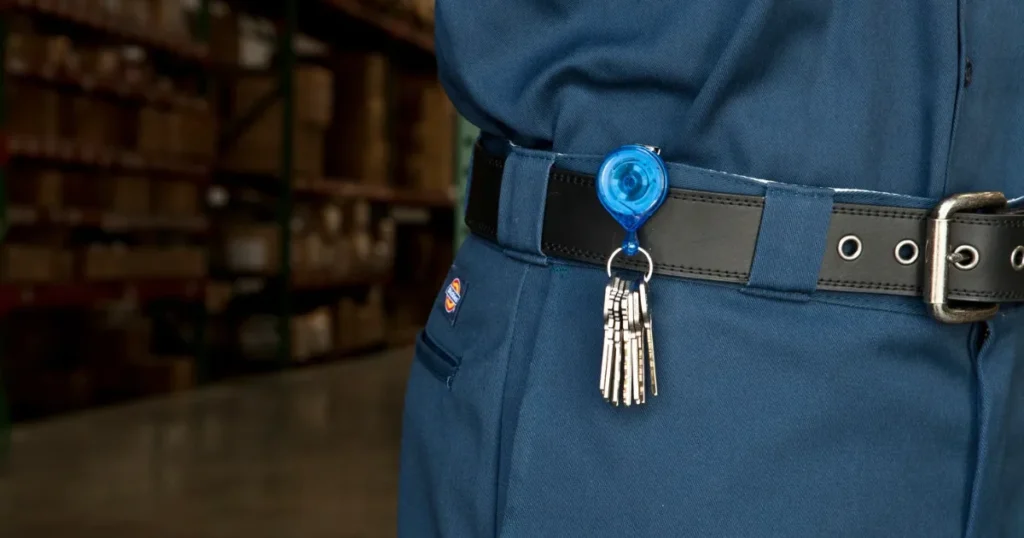
The belt: the reference configuration
This is the most widespread and simplest fixation to implement. A belt offers solid support, at a height consistent with most access points, and compatible with all Key-Bak models.
The integrated belt clip on models like the SUPER48 or’ORIGINAL slides directly onto a standard 3 to 5 cm wide belt. It holds firmly without slipping, and is easily removed at the end of service.
For wider tactical or professional belts, often worn by security guards or technicians, the’KK2 All-purpose belt clip It is the appropriate solution. It is designed to fit belts of different thicknesses and widths, including non-standard configurations.
To remember for the belt: This is the position that offers the best compromise between stability, carrying height, and accessibility. If your work clothing has a belt, this is where you should start.
The work jacket or the professional vest
Many professionals wear a work jacket or waistcoat without an integrated belt. This is the case for technicians, maintenance workers, construction professionals, or warehouse employees who wear multi-pocket jackets or sleeveless vests.
In this case, several options exist. The standard clip can be attached to the lower edge of the vest or to an external pocket if the fabric thickness allows. For a more secure attachment on thick fabric or a padded vest, the’KK2 All-purpose belt clip Offers a better grip thanks to its adjustable design.
On a jacket with a chest pocket, it is also possible to attach the reel to the top edge of the pocket. This position is higher up on the body, which means choosing a longer cable is necessary to maintain comfortable access to locks and badge readers located at hand-height. A 90 cm cable is generally recommended in this configuration.
The Ratch-It With its integrated carabiner, it is particularly suitable for vests and jackets that have loops or attachment points: it fastens in one click without requiring a belt clip.
To remember for the jacket or the waistcoat: The fixing height varies depending on the chosen location. Anticipate this impact on the necessary cable length, and favour fixing to a solid point on the garment rather than to soft fabric which would deform under the weight of the keyring.
The blouse: the challenge of lightweight fabric without a belt
The blouse is the most restrictive garment for attaching a retractable reel. It is lightweight, often without a belt, and made of fabric that does not tolerate a localised load well. And yet, it is in this context, for healthcare professionals, medical reception staff and laboratory personnel, that the need to have badges and keys readily available is greatest.
Several solutions exist depending on the configuration of the blouse.
If the blouse includes a chest pocket with a stiff or reinforced edge, the standard clip will attach to it correctly on compact models such as the Key-Bak 6C or the 6C-ID. These models are light enough not to distort the fabric or pull on the pocket.
If the blouse does not have a pocket that can be used for this attachment, the MINI-BAK Badge holder It is the best option. Its ultra-compact size and minimal weight make it the most suitable model for lightweight fabrics. It can be attached to the collar of a blouse, to a reinforced buttonhole or to a pocket trim without deforming the garment.
For carers who wear a badge permanently and need to keep it visible, the Key-Bak 6 ID The chest pocket clip is a classic and effective setup.
To remember for the blouse: Choose the most compact and lightest models in the range. Avoid attaching a heavy reel like the SUPER48 directly to a light blouse without a solid support: the fabric will deform and the attachment will be uncomfortable.

The apron: an often overlooked configuration
The apron is common in catering, the food trade, crafts, and certain industrial roles. It generally does not have a belt in the strict sense but features a strap around the waist or a drawstring that can serve as a fastening point.
On an apron with a waist strap, the standard clip often fits correctly if the strap is sufficiently rigid. The’KK2 All-purpose belt clip This is also a safer option if the strap is thin or flexible.
The Ratch-It With a carabiner, it can also be attached directly to a lanyard or a harness ring if the model has one. This is a quick and secure solution that does not require a belt clip.
For short aprons without a waist strap, attachment to the garment worn underneath is often more practical. If the professional is wearing trousers with a belt under the apron, this is where the reel will find its best position.
To remember about the apron: The fastening depends greatly on the shape and construction of the deck. First, identify the most solid and stable point available—whether it's the strap, a ring, or the garment being worn underneath.
The uniform without a belt or structured pocket
Certain uniforms, particularly in high-end hotels, fine dining restaurants, or certain reception roles, have neither a belt nor a usable chest pocket. A smart appearance is a requirement, and a poorly integrated retractable badge holder can detract from a professional image.
In this context, two approaches are possible. The first involves fixing the winder invisibly or discreetly onto an inner seam or the edge of a jacket, using a fine clip that will not distort the garment. The MINI-BAK and the 6C are the most discreet models for this setup.
The second approach is to use the Quick release QR500 as an intermediate attachment point, which allows the retractor to be fixed to an invisible point under the garment, with only the cable and the carried object emerging when necessary.
To remember for standard unissued uniform: discretion is possible without sacrificing practicality. The compact models in the range and the fixing accessories allow for a solution that adapts to almost any clothing configuration.
The right reflex before choosing your binding
Before deciding how to attach your Key-Bak, ask yourself three simple questions. Where are the access points that I use most often, locks, badge readers, time clocks? How high are they in relation to my height? And which attachment point on my clothing allows me to reach these points comfortably with the chosen cable?
The answers to these three questions naturally guide towards the correct model, cable length, and fixing. The range of’Key-Bak accessories is there to cover non-standard configurations, with fixing options suitable for almost all types of professional clothing.
Find all Key-Bak fixing accessories on key-bak.fr.
